Buying a cute table and chair set is easy. Choosing the Kids Table and Chair Size that actually fits your child is the harder part.
When a chair is too high, a child’s feet may not rest properly on the floor. When the table is too high, shoulders can rise and arms may become uncomfortable during drawing, writing or crafts. Current children’s furniture guides commonly recommend checking the child’s seated position rather than relying on age labels alone.
For UAE homes, the decision also needs to account for room size, the purpose of the furniture, and whether the same setup will be used for meals, crafts, reading or study.
This practical guide explains how to choose the right size without relying on guesswork.
Why Kids Table and Chair Size Matters
Children use tables and chairs for much more than homework. A well-fitted set can become a place for drawing, puzzles, reading, snacks, crafts and quiet play.
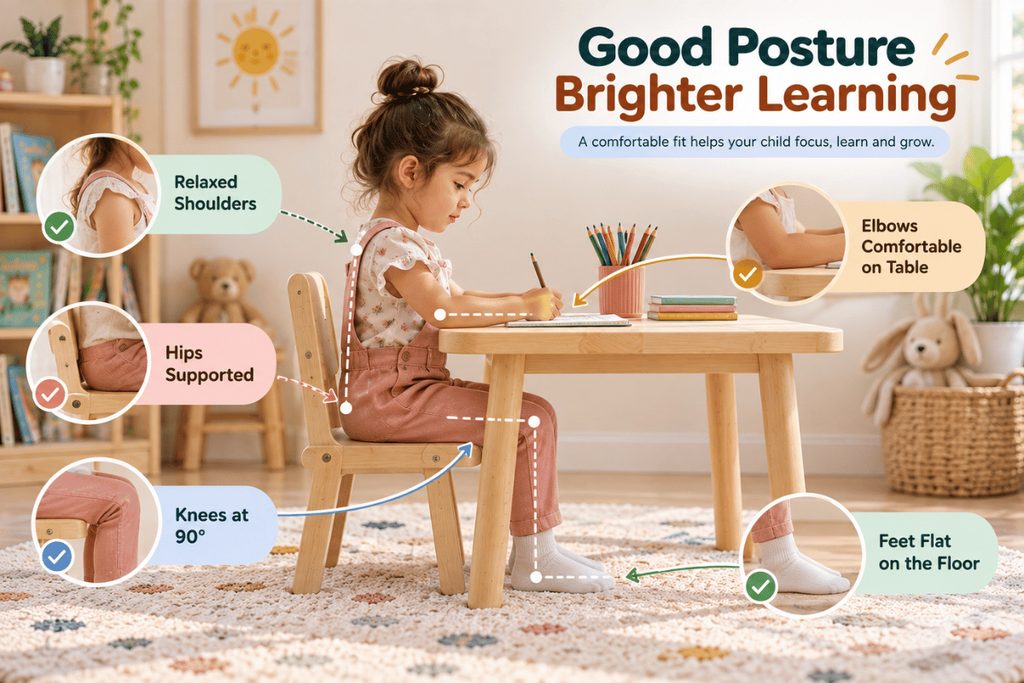
The fit matters because the child’s body needs enough support while sitting. A practical check is to look for feet flat on the floor, knees comfortably bent, and forearms reaching the tabletop without forcing the shoulders upward. Similar positioning checks are recommended across current childcare and classroom furniture sizing guides.
A correctly sized set can also make independent use easier. A child who can sit down, stand up and use the table without struggling is more likely to use the furniture naturally.
Kids Table and Chair Size: Start With Your Child, Not the Furniture
A common mistake is buying furniture first and checking the child’s measurements later.
Age can be a useful starting point, but it is only a guide because children of the same age can have very different heights. Recent sizing resources explicitly recommend using the child’s actual height and seated position when choosing furniture.
Before buying, measure:
- Your child’s standing height
- Approximate seated knee height
- Available room width and depth
- The space needed to pull the chair out
- The activities the child will perform at the table
This gives you a much better starting point than choosing a set simply because the packaging says “ages 3–5”.
1. Match Chair Height First
The chair is the foundation of the setup.
When your child sits properly, their feet should rest comfortably on the floor rather than dangling. Their knees should remain comfortably bent, with enough space between the seat edge and the back of the knees.
As a practical reference, several current sizing guides place preschool chair seats around 10–12 inches and older early-primary sizes progressively higher, but exact needs vary by child and manufacturer.
For younger children, a correctly scaled seat can also make everyday tasks feel more manageable.
For example, a Toddler Chair can be considered when creating a low-height activity or seating area for younger children.
2. Make Sure the Table Works With the Chair
Buying the table and chair separately can create a poor fit even when both pieces look appropriate on their own.
Current classroom sizing guidance commonly uses a table height roughly 8–10 inches above the chair seat, while the most useful final test is still how the child actually sits and reaches the tabletop.
For example:
| Chair Seat Height | Approximate Table Height | Typical Use |
|---|---|---|
| 8–10 in | 14–18 in | Toddler activities |
| 10–12 in | 18–20 in | Preschool activities |
| 12–14 in | 20–22 in | Kindergarten / early primary |
| 14–16 in | 22–24 in | Older children |
These are general reference ranges, not rigid rules. Manufacturer specifications and the child’s actual body fit should always take priority. Different sizing systems use different age brackets and measurements.
For flexible layouts, a Primary Chair can be considered for a more developed children’s seating setup.
3. Check the 90-Degree Sitting Position
Rather than memorizing one number, observe the child sitting naturally.
A useful visual check is:
Feet: flat on the floor
Knees: comfortably bent around 90 degrees
Hips: supported by the chair
Elbows: able to reach the work surface comfortably
Shoulders: relaxed rather than lifted
The exact posture should be checked on the actual furniture because a child’s proportions, seat depth and table thickness can all change the final fit.
A Quick Fit Test
Ask your child to sit at the table and draw or write for a few minutes.
Look for signs such as:
- Feet dangling
- Knees pushed awkwardly under the tabletop
- Shoulders raised
- Child leaning excessively forward
- Difficulty reaching materials
- Constantly moving because the setup feels uncomfortable
These signs can indicate that the furniture dimensions should be reviewed.
4. Choose the Table Size According to Its Main Purpose
Not every children’s table needs the same dimensions.
A table used for drawing and crafts needs enough surface area for paper, crayons, paints and other materials.
A table used for snacks may need a simpler, easier-to-clean surface.
A table used for building and sensory activities may benefit from a more specialized design.
For example, a Rectangle Shaped Table for Kids can work well when a room needs a straightforward work surface with defined seating positions.
For shared activities or multiple children, larger or alternative shapes may be more practical.
5. Measure Your Available Room Before Buying
Even a correctly sized table can become a poor choice when the room around it is too small.
Measure the actual floor area before ordering. Consider:
Table footprint + chair clearance + walking space = required floor area
The chair needs enough room to move backward when a child sits down or stands up. You also need clear space around the furniture so children do not have to squeeze through a narrow gap.
Nilkamal’s guidance also places room measurement near the top of its buying criteria and recommends checking the available space before selecting children’s tables and chairs.
For small UAE bedrooms and apartments, a compact table can be more useful than choosing the largest tabletop available.
6. Select the Shape for the Way Children Will Use the Space
Shape affects both usability and room planning.
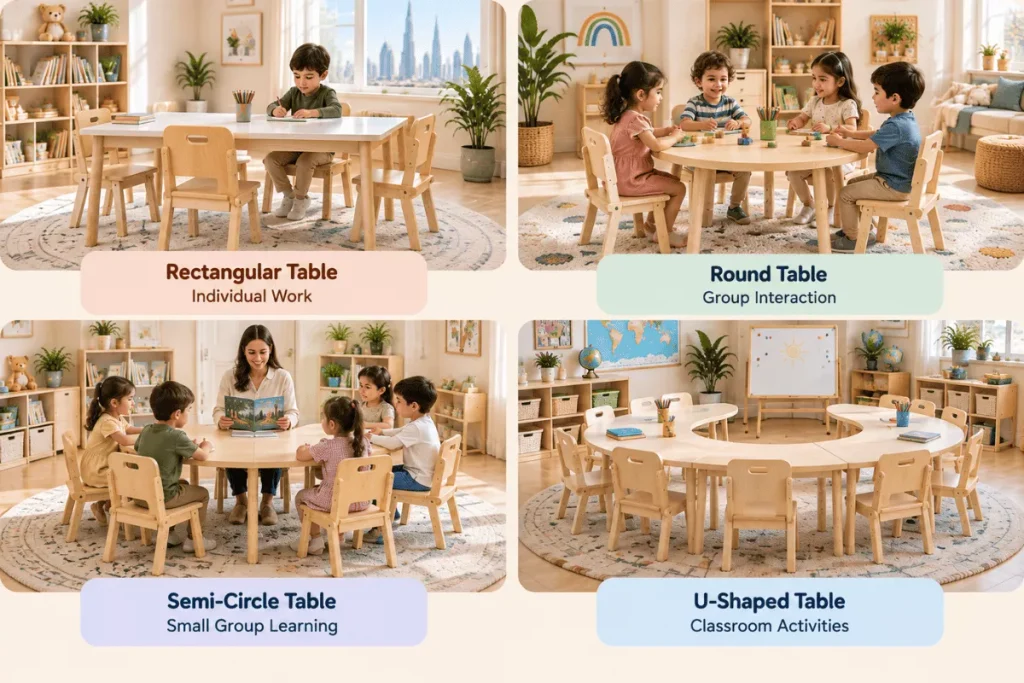
| Table Shape | Best For |
|---|---|
| Rectangular | Individual work and structured activities |
| Round | Group activities and shared interaction |
| Semi-circle | Small group learning and flexible placement |
| U-shaped | Supervised group work and classroom layouts |
| Square | Compact rooms and simple setups |
A Semi-Circle Table can be useful where children need to work together while keeping the furniture footprint more controlled.
For classrooms, a U-Shaped Table for Classrooms and Playrooms can create a more defined group-work arrangement.
The goal is not to find the “best” table shape overall. It is to find the shape that works best with the number of children, activity and available floor space.
7. Think About Materials, Storage and Long-Term Use
Size is the most important starting point, but it should not be the only buying factor.
Current competitor guides also emphasize material, durability, maintenance, storage, stability and flexibility when comparing children’s furniture.
Material
Choose a material that suits the environment and expected use. Children’s furniture may experience spills, crayons, craft materials and everyday wear.
Storage
For activity areas, built-in storage can reduce clutter and keep supplies close to the table.
A Reversible Chalkboard Table with Storage is an example of furniture that combines a work surface with an additional activity or storage function.
Durability
Look for a stable construction suitable for regular children’s use rather than choosing only on appearance.
Flexibility
A furniture piece that supports more than one activity can provide better value, especially in smaller rooms.
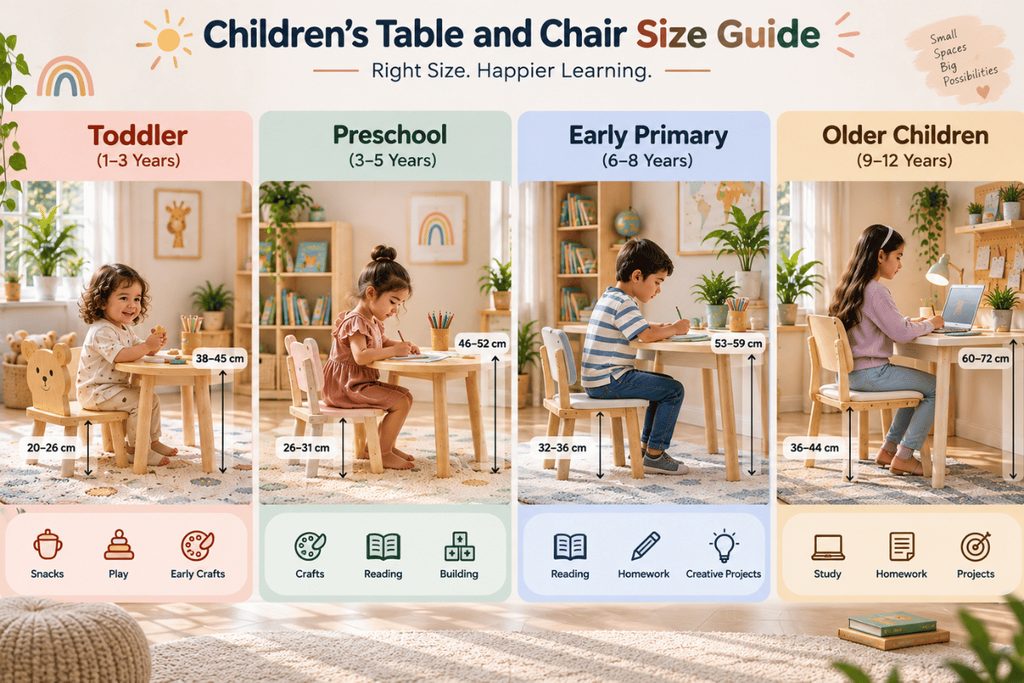
Kids Table and Chair Size by Age: A Practical Reference
Age-based charts can be useful for narrowing down options, but they should never replace an actual fit check.
| Age Group | Typical Chair Seat Range | Typical Table Height Range | Common Use |
|---|---|---|---|
| Toddlers | 8–10 in | 14–18 in | Snacks, sensory play, drawing |
| Preschool | 10–12 in | 18–20 in | Crafts, puzzles, reading |
| Early Primary | 12–14 in | 20–22 in | Writing, projects, group work |
| Older Children | 14–16 in | 22–24 in | Study and structured activities |
These ranges are a practical synthesis of current children’s and classroom furniture sizing references; manufacturers may use different size systems, so always compare the actual product dimensions before purchasing.
Fixed-Height vs Adjustable Kids Tables
Adjustability sounds attractive because children grow quickly, but it is not automatically the best choice.
Fixed-height tables
Fixed-height tables are straightforward and can work very well when the furniture is selected specifically for the child’s current size.
They are especially useful when a room serves children within a fairly narrow age range.
Adjustable tables
Adjustable-height furniture can be useful when one table needs to accommodate changing heights or different users. It can also help in mixed-age or specialized settings.
However, adjustability should not be treated as a substitute for checking the actual fit. A table can have an adjustable mechanism and still be set incorrectly.
For home use, choose adjustability when it solves a real problem rather than simply because the feature sounds useful.
How to Choose Kids Furniture for a Montessori Setup
Montessori-inspired spaces often emphasize child-sized furniture and accessible environments.
The goal is to make everyday activities easier to approach independently, whether the child is reading, drawing, eating or completing a simple activity.
A Simple Montessori Chair for Kids can work well as part of a low, child-accessible activity area.
The table should similarly allow the child to sit comfortably, reach the work surface and use the space without unnecessary adult assistance.
For broader room planning, the Montessori Play Setup guide can be used alongside the furniture-sizing decisions.
Kids Table and Chair Setup Ideas for Small Rooms
In a small bedroom or apartment, every piece of furniture needs to earn its space.
Instead of choosing a large table, start by asking what the child actually does there. A compact drawing station may need far less floor space than a shared craft table.
A few useful strategies include:
Keep the table close to its activity zone
Place art supplies near an art table, books near a reading area, and sensory materials near the appropriate activity station.
Avoid oversized chairs
An oversized chair can take more floor space while still giving the child a poor fit.
Use multi-purpose furniture
Furniture that supports drawing, play and storage can be especially valuable in smaller rooms.
For more ideas on children’s room planning, the Kids Tables & Chairs UAE Guide can be used as a broader furniture reference.
Kids Table and Chair Size for Classrooms
Classrooms have a different challenge because several children may need to use the same furniture at the same time.
Avenlur’s current classroom sizing guide uses separate table and seat-height ranges by age and recommends considering the chair-to-table relationship rather than choosing table height in isolation.
The Bureau of Indian Standards also defines dimensional recommendations for school tables and chairs for children aged 5–17, including considerations such as knee space and working-surface dimensions.
For mixed-age environments, it can therefore be more practical to use different chair sizes or furniture sizes rather than expecting one standard setup to fit every child.
Common Kids Table and Chair Buying Mistakes
Choosing only by age
Age labels are convenient, but children in the same age group can differ significantly in height.
Buying the table before the chair
The table and chair need to work together. Buying one without checking the other can create an uncomfortable relationship between seat and tabletop.
Ignoring legroom
A child needs enough space under the table to sit naturally and move their legs.
Choosing the biggest table possible
A large table is not automatically better. Oversized furniture can make a small room harder to use.
Prioritizing appearance over fit
A beautiful set that is uncomfortable will quickly become unused furniture.
Forgetting how the furniture will actually be used
Drawing, reading, meals, sensory activities and study may all require different features.
How to Test a Kids Table and Chair Before Buying
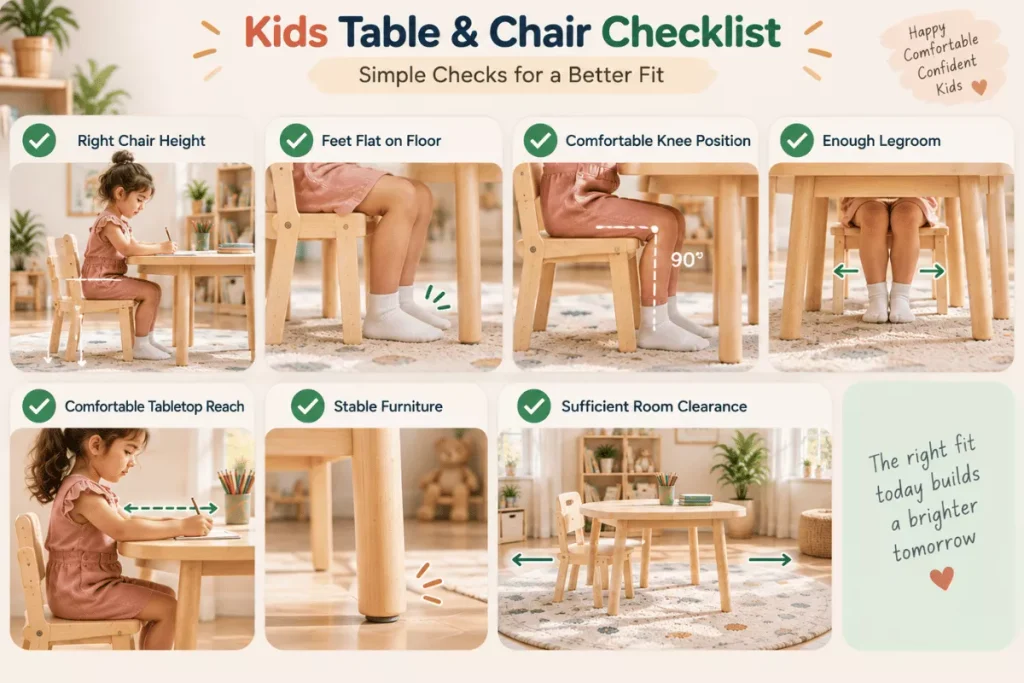
Before finalizing your purchase, use this simple checklist.
Step 1: Have the child sit fully back in the chair.
Step 2: Check whether both feet reach the floor comfortably.
Step 3: Check that the knees can bend naturally.
Step 4: Observe the shoulders while the child uses the table.
Step 5: Check whether the child can reach the tabletop without stretching.
Step 6: Make sure there is enough legroom underneath.
Step 7: Confirm that the furniture fits comfortably inside the room.
This practical test is more useful than relying on a single age recommendation.
Before choosing a children’s table and chair, it is also worth checking basic furniture safety guidance. The U.S. Consumer Product Safety Commission recommends securing furniture such as bookcases and other tip-over-prone furniture to help protect children. CPSC furniture safety guidance.
FAQs
What is the best table height for a child?
There is no single table height that fits every child. A practical starting point is to match the table with the chair so the child can sit with feet flat, knees comfortably bent and forearms reaching the tabletop without raised shoulders.
What chair height is suitable for toddlers?
Toddlers generally need much lower chair seats than preschool and school-age children. Current sizing guides commonly place toddler seating around the 8–10 inch range, but the actual child’s fit should determine the final choice.
Should I choose a kids table based on age or height?
Height and actual seated fit are more reliable than age alone. Age is useful for narrowing choices, but children grow at different rates.
How much space should be under a kids table?
There should be enough clear space for the child’s knees and legs to move without hitting the underside or supports. School furniture standards specifically consider minimum knee space when defining table dimensions.
Is an adjustable kids table better?
Not necessarily. Adjustable furniture is useful when different heights need to be accommodated, but a correctly fitted fixed-height table can work very well for a child or age group with similar dimensions.
What is the best table shape for kids?
It depends on how the furniture will be used. Rectangular tables suit structured individual work, round tables support group interaction, and semi-circle or U-shaped tables can work well for shared classroom activities.
Can one kids table work for siblings?
Sometimes, but only when the chair heights and tabletop relationship work for both children. With a noticeable height difference, separate seating or adjustable furniture may be more practical.
Conclusion
Choosing the right Kids Table and Chair Size is about much more than picking a furniture set labelled for a particular age.
Start with your child’s actual height and seated position. Then check the relationship between chair and tabletop, available legroom, room dimensions, intended activities, materials and long-term practicality.
The most useful setup is the one that allows your child to sit comfortably, reach the work surface naturally, move independently and use the furniture every day.
Whether you are creating a toddler activity corner, a Montessori workspace, a playroom craft station or a classroom learning area, the right size should always come before decorative style.