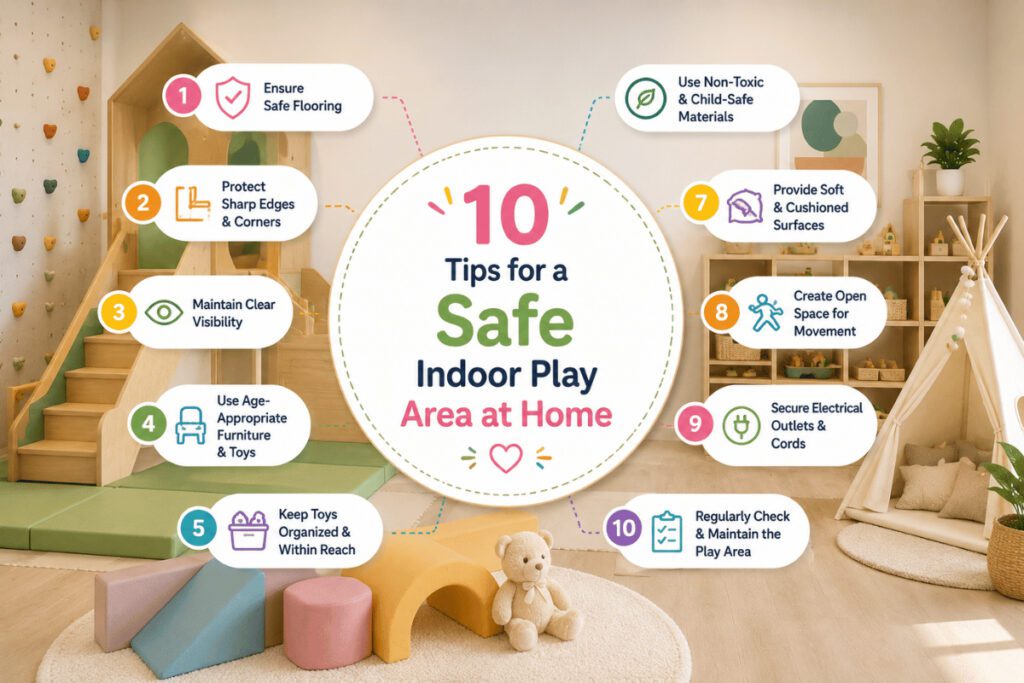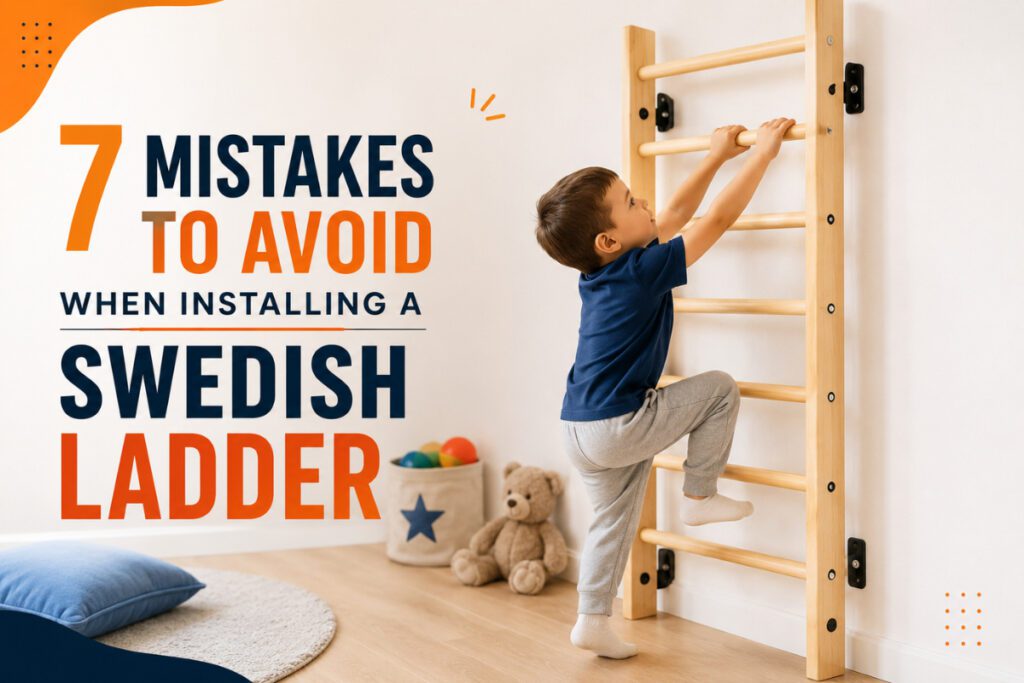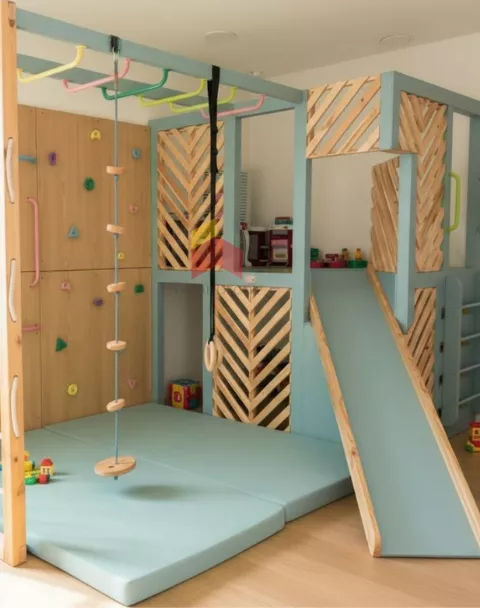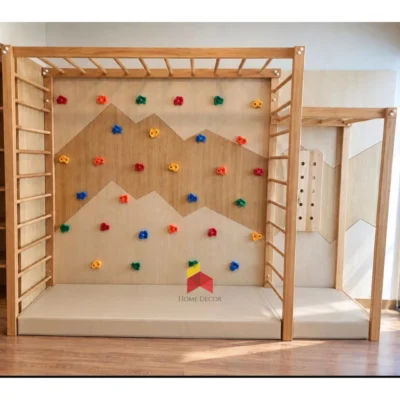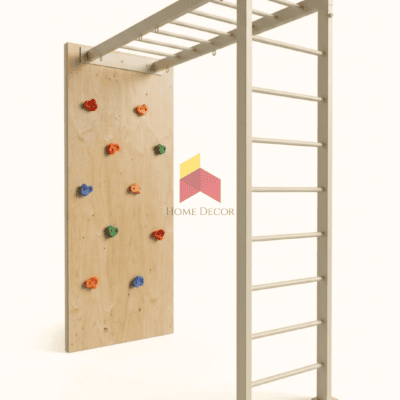
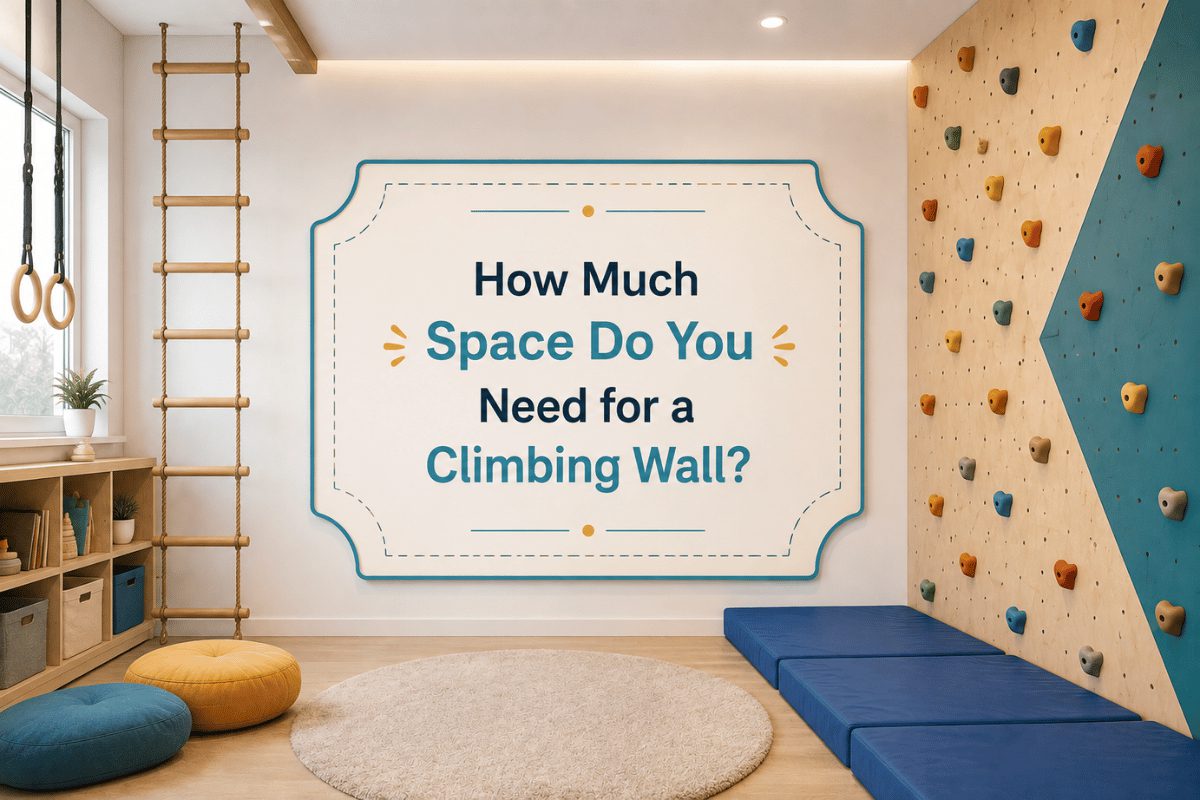
Space Do You Need for a Climbing Wall? The answer depends on more than the width of the wall itself. Before adding a climbing wall to a kids’ playroom, bedroom, school, recreation space, or indoor activity area, consider the wall’s height, width, angle, surrounding clearance, safety surfacing, ceiling height, and the age and number of children who will use it. The required space can vary depending on the type of climbing wall and how the area will be used.
A climbing wall can be a valuable addition to a children’s play environment because it encourages active movement, coordination, balance, grip development, and physical confidence. But the available room has to be planned carefully. A wall that fits physically may still leave too little space for safe movement, supervision, landing areas, or other activities.
The good news is that a climbing wall does not always require a huge room. With the right design, even a relatively compact area can support an engaging climbing setup.
| Climbing Wall Type | Suggested Height | Suggested Width | Space Considerations |
|---|---|---|---|
| Basic Vertical Wall | 6–8 ft | 8–12 ft | Works well for smaller indoor spaces and beginner-friendly climbing |
| Standard Indoor Wall | 10–12 ft | 12–20 ft | Provides more room for varied climbing movements and routes |
| Overhanging Wall | 12–16 ft+ | 12–20 ft+ | Requires additional space because the wall projects outward |
| Commercial Bouldering Area | 14–20 ft | Depends on site | Needs a larger footprint, safety flooring, circulation space, and careful planning |
What Determines the Space Needed for a Climbing Wall?
There is no single room size that works for every climbing wall. The required space changes according to how the wall will be used and how it is designed.
The main factors include:
- Wall width
- Wall height
- Wall angle
- Ceiling height
- Clearance around the structure
- Safety or impact-absorbing flooring
- Number of users
- Age and ability of the children
- Whether the wall is vertical, angled, or overhanging
For example, a simple traverse-style wall may need considerably less vertical space than a taller climbing installation designed for more challenging routes.
This is why measuring the wall alone is not enough. The complete climbing area should be considered before installation.
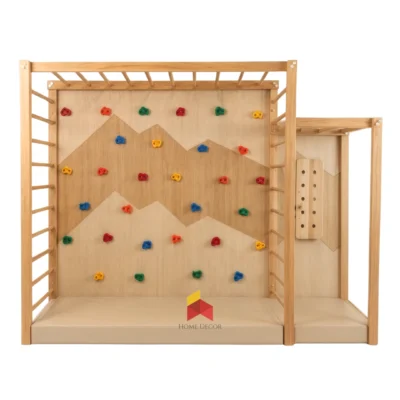
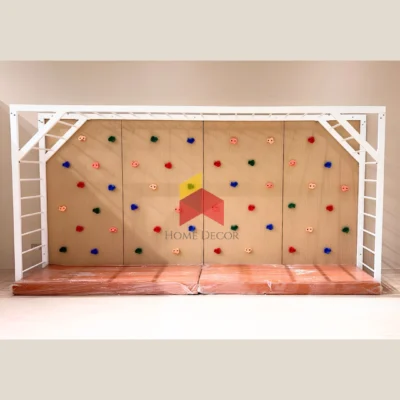
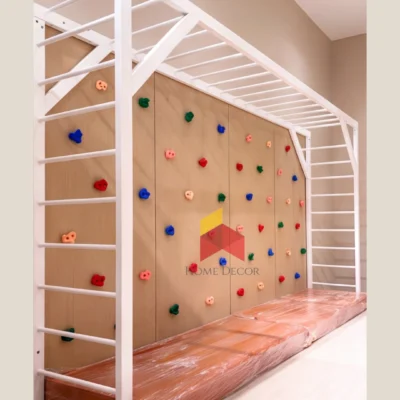
For families creating a safe and active indoor play space, the Climbing Wall With Mattress | Single Panel is a practical option that combines climbing fun with a cushioned landing area.ace.
How Much Width Do You Need?
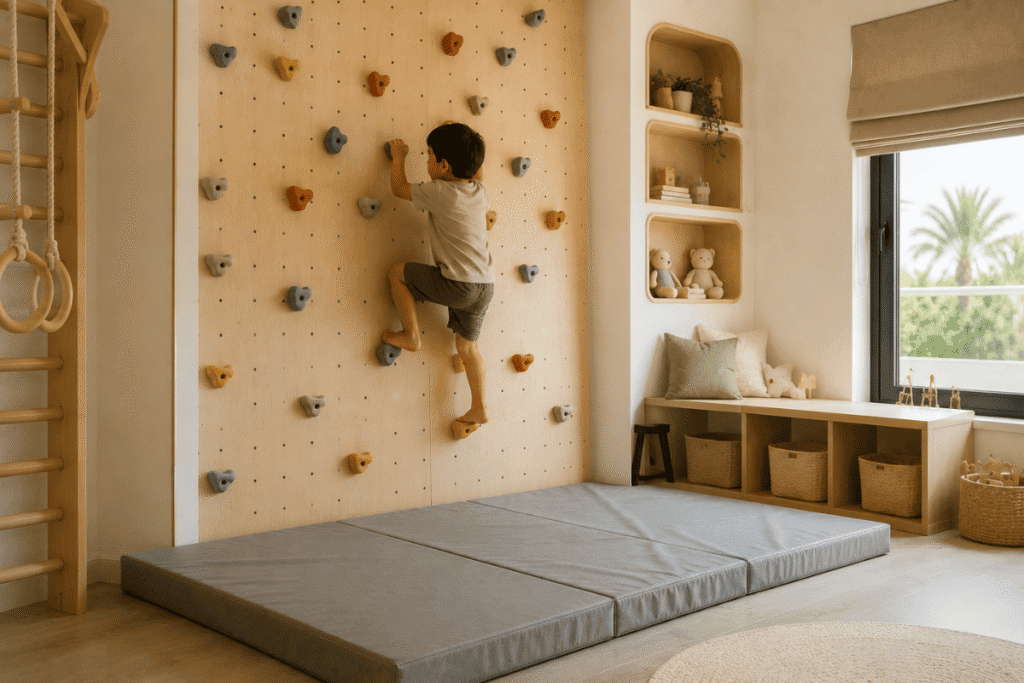
Wall width plays an important role in determining how much climbing variety children can enjoy.
For a very small setup, a shorter wall may be sufficient for basic climbing or sideways movement. However, a wider wall gives children more room to move between holds and allows designers to create more varied climbing patterns.
The competitor sources provided for this topic suggest that residential setups can start around 8 feet of width, while approximately 12 to 20 feet can provide more room for varied movement and route planning. Another source notes that some home bouldering installations use around 8 to 12 feet of width depending on the available room.
These figures should be treated as planning examples rather than universal requirements. The actual dimensions should be based on the specific product, installation method, intended users, and safety requirements.
For smaller homes, a compact installation can still work well when the wall is integrated into an existing play area instead of taking over the entire room.
Families can also consider climbing walls for kids when deciding what style and size would work best for their available space.
How Much Height Does a Climbing Wall Need?
Height is one of the most important measurements because it affects both the challenge level and the amount of clearance required.
The competitor research gives several useful residential reference points:
- Around 6 to 8 feet can work for a basic vertical wall.
- Around 8 to 12 feet can provide more opportunities for vertical climbing.
- Around 12 to 16 feet can support a more substantial bouldering experience where the room and safety setup allow it.
The right height for a children’s climbing wall can be much lower than a commercial climbing facility. For younger children, a lower wall can make it easier to design age-appropriate challenges and maintain closer supervision.
The U.S. Consumer Product Safety Commission also distinguishes climbing equipment by age and notes that some climbing activities may be more challenging for younger preschool children because they are still developing balance, coordination, and upper-body strength.
The key point is simple: do not choose wall height first and try to make the rest of the room fit around it. Decide how children will use the wall, then choose dimensions that support that purpose.
Don’t Forget the Space Around the Wall
One of the easiest mistakes is measuring only the wall surface.
Children need room around the installation for movement, access, supervision, and safe use. The exact clearance depends on the type of climbing wall and its installation requirements, so manufacturers’ specifications should always be reviewed before installation.
The competitor research includes residential recommendations of approximately 12 to 18 inches of space around an indoor bouldering wall for installation access. A commercial or higher climbing structure may require substantially more room.
The floor area is particularly important.
A climbing wall should not be placed directly against:
- Hard furniture
- Sharp corners
- Glass surfaces
- Unprotected columns
- Other active play equipment
- Obstacles that could interfere with movement
A well-planned playroom should leave enough open space for children to move naturally between the climbing area and other activities.
For additional ideas on organizing a children’s activity space, see our guide to indoor play area for kids.
Ceiling Height Matters Too
The room’s ceiling height can determine which type of climbing wall is practical.
A compact vertical installation may work comfortably in a standard-height room, while taller or angled walls require additional overhead clearance.
The competitor sources indicate that a simple home bouldering setup can work with a ceiling around 8 feet, while taller installations require more vertical space. One source also notes that overhanging configurations can require considerably greater ceiling height.
The exact requirement will depend on the wall’s design, angle, height, and the way it is installed.
For children’s spaces, the objective should not be to use the maximum possible height. A better approach is to choose a configuration that provides an appropriate level of challenge while allowing adults to supervise comfortably.
Vertical vs. Angled Climbing Walls
The type of climbing wall you choose can change the amount of floor and ceiling space required.
Vertical Climbing Walls
A vertical wall sits relatively close to the room’s existing footprint. It can be a practical choice for:
- Kids’ bedrooms
- Playrooms
- Classrooms
- Activity rooms
- Compact indoor recreation spaces
This configuration is often easier to integrate into an existing room.
Angled or Overhanging Walls
Angled walls extend farther into the room and therefore require more planning.
As the wall angle increases, the structure can occupy more floor area. The climbing experience can also become more physically demanding.
This means you need to consider not just the wall’s height and width, but also the amount of room the structure projects away from the supporting surface.
For a children’s playroom, a moderate configuration may offer a better balance between challenge and practical space use than a highly aggressive overhang.
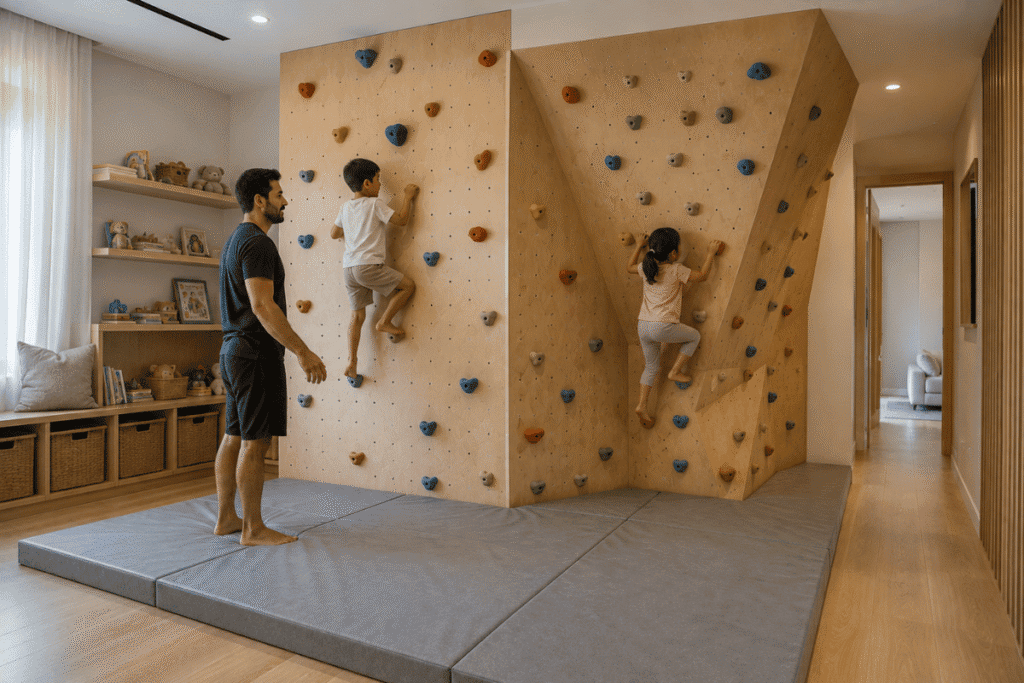
How Many Children Will Use the Wall?
The number of users also affects the amount of space you need.
A wall designed for one child at a time can be much more compact than a setup intended for several children.
Think about the likely use:
One child: A compact wall may be enough for individual play.
Two children: Additional width and clear floor space can help prevent interference.
Multiple children: A larger installation and carefully planned circulation become increasingly important.
For schools and childcare spaces, this becomes even more important because traffic can build up quickly. The climbing area should be positioned so that children waiting for their turn do not interfere with children actively climbing.
The CPSC recommends considering traffic flow when climbing components are part of a larger playground structure so that movement at one activity does not interfere with nearby activities.
Safety Flooring Should Be Part of the Space Plan
Safety surfacing should be considered before the climbing wall is installed, not added as an afterthought.
The type of climbing activity, fall height, equipment design, and applicable safety requirements all influence the appropriate protective surface.
For public playground environments, the CPSC emphasizes shock-absorbing protective surfacing under and around elevated play equipment because falls are a major source of playground injury.
For a home or indoor children’s play area, the same planning principle is useful: the area beneath and around climbing equipment should be designed specifically for the type of activity taking place there.
Our best flooring for kids’ play areas guide can help when comparing suitable flooring options for children’s spaces.
You can also explore wall padding mats for safety when the room design calls for additional protection around walls or other hard surfaces.
What About Small Rooms?
A small room does not automatically rule out a climbing wall.
In fact, compact climbing installations can work especially well when the wall is treated as part of the room’s overall design rather than as a separate piece of equipment.
For example, a small playroom may combine:
- A compact climbing wall
- Open floor space
- Soft flooring
- Low storage
- A reading corner
- Other movement-based activities
The goal is to avoid filling the room with equipment.
A successful small-space design gives children enough room to climb while keeping clear circulation paths and maintaining a comfortable environment for adults.
Families living in apartments can also explore ideas from our guide to an indoor climbing frame for apartments for ways to use limited indoor space efficiently.
Choosing the Right Location
Where you install the wall can be just as important as its dimensions.
Potential locations include:
Kids’ Playroom
A playroom is often the easiest option because the room is already designed around children’s activities. A climbing wall can become one active zone within a larger play environment.
Bedroom
A compact wall can work in a child’s bedroom when enough clear floor space remains for movement and other furniture.
School or Classroom
Schools should consider supervision, traffic flow, age groups, accessibility, and the relationship between the climbing area and other activities.
Recreation or Activity Room
A larger room provides more flexibility for combining climbing with other physical activities.
The right location should provide enough room not only for the climbing structure but also for the children and adults using the surrounding area.
How to Measure Your Room Before Buying
Before choosing a climbing wall, take measurements from several directions instead of measuring only one wall.
Record:
- Total wall width
- Ceiling height
- Floor depth available
- Door locations
- Windows
- Furniture placement
- Columns or fixed obstacles
- Electrical points
- Ventilation or HVAC elements
- Available open floor area
Then mark the proposed climbing wall on the floor using tape.
This simple step can show whether the installation feels too large once you account for movement and surrounding furniture.
It is also useful to leave enough flexibility for cleaning, maintenance, and future changes to the room.
Match the Wall to the Child’s Age
Space planning should always be connected to the child’s developmental stage.
Younger children may need lower, simpler climbing challenges, while older children can often handle more complex movement patterns.
The CPSC notes that climbing equipment can require balance, coordination, and upper-body strength that younger preschool children may not yet have fully developed.
For this reason, a climbing wall should not be selected simply because it looks impressive. The wall should match the users’ abilities, the intended level of challenge, and the available supervision.
For a broader approach to children’s physical environments, our guide to safe kids play area design covers additional factors to consider when planning an active play space.
Can a Climbing Wall Fit Into a Multi-Activity Room?
Yes, but the layout needs to be intentional.
A climbing wall can share space with:
- Soft play
- Balance equipment
- Sensory activities
- Reading areas
- Pretend play
- Storage
- Open movement zones
However, active and quiet activities should not compete for the same space.
For example, a climbing wall should not open directly into a narrow passage used by children moving between other play areas.
A larger multi-purpose room may benefit from clearly defined zones so that climbing, social play, and quieter activities each have their own space.
Parents and designers looking for compatible movement equipment can also review climbing structures as part of a broader indoor play setup.
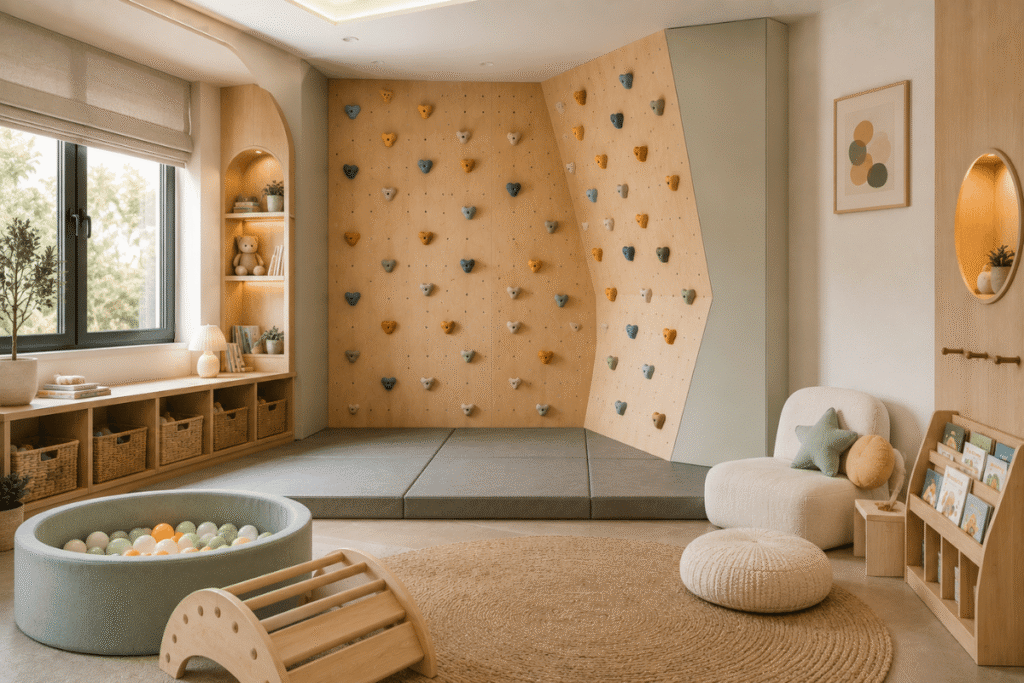
A Practical Space-Planning Checklist
Before purchasing or installing a climbing wall, check these points:
- Is the wall suitable for the child’s age and ability?
- Is the ceiling high enough for the selected design?
- Is there enough width for the intended climbing activity?
- Is there sufficient floor space in front of and around the wall?
- Can adults supervise the area easily?
- Is suitable protective flooring planned?
- Are there nearby furniture pieces or hard surfaces that create hazards?
- Can children move safely around the climbing area?
- Does the installation leave enough room for other activities?
- Can the wall be cleaned, inspected, and maintained easily?
The CPSC’s current Public Playground Safety Handbook provides additional guidance on climbing equipment, layout, fall height, and protective surfacing for public playground environments.
Frequently Asked Questions
How much room do you need for a small climbing wall?
A compact wall can fit into a relatively small playroom, but the exact room size depends on the wall’s dimensions, height, angle, installation method, and safety requirements. Some residential guidance starts around 8 feet of wall width, but more width provides greater route variety.
How high should a kids’ climbing wall be?
There is no single height that works for every child or room. Lower walls are generally more appropriate for younger users, while taller walls can provide more challenging climbing. The available ceiling height and safety setup must also be considered.
Do you need extra space in front of a climbing wall?
Yes. The wall itself is only one part of the installation. The surrounding floor area needs to accommodate movement, access, supervision, and appropriate protective surfacing.
Can you install a climbing wall in a small bedroom?
Yes, provided the room has enough usable wall and floor space for the selected installation. A compact vertical climbing wall is generally easier to integrate than a large angled or overhanging design.
Is a climbing wall suitable for toddlers?
Some climbing equipment can be appropriate for younger children, but the design must match their developmental abilities. Younger children may struggle with climbing equipment that requires greater balance, coordination, or upper-body strength.
Final Thoughts
The answer to How Much Space Do You Need for a Climbing Wall? depends on the complete installation rather than one measurement.
Wall width, height, angle, ceiling clearance, floor area, protective surfacing, room layout, and the number and age of users all matter. A compact vertical wall may work well in a home playroom, while a larger installation may require a dedicated activity room.
The smartest approach is to measure the whole space first, define how the children will use the wall, and then choose a climbing solution that fits those needs.
A climbing wall should add movement and excitement without making the room feel crowded. With careful planning, even a modest indoor space can become an engaging and practical environment for active play.